

How To Clean And Maintain Lionel Postwar Locomotive
Frequently Asked Questions
Categories of Questions and Answers
Train Values and Selling My Trains
Unique and Valuable Lionel Trains
Parts and Service for My Trains
Operating My Trains
Sizes of Lionel Trains
Lionel Fastrack Layouts and Operation
LCCA Fastrack Modules and Standards
Lionel Customer Programs
Software - Inventory, Rails Planning, etc.
Storage Weather and Packaging of Trains
Train Values and Selling My Trains
Q: How and where can I sell my trains?
A: First off every bit a member of the LCCA you can advertise for FREE to other members of our social club in our quarterly publication The Interchange Track. Some other popular place is eBay which is an auction site and quite extensive but comes with costs associated with selling them. There are besides national auction companies that specialize in selling trains. They typically advertise their auctions in magazines such every bit Classic Toy Trains and O Approximate Railroading. These national companies primarily deal in highly collectible trains and average run of the mill trains are of picayune interest to them, withal. Yous could also bank check with local hobby shops in your area or you might also be able to get a tabular array at a local railroad train bear witness and sell them there. Often these rent from $10-50 each. However, y'all volition demand to have done some research to do the pricing. Overprice them and y'all will accept them abode with you and exist out the toll of the tables to boot. Lastly, y'all might try Craigslist or a for sale advertisement in your local newspaper to annunciate them for sale.
Q. I have a "bunch" of Lionel trains and accessories. Some are in "good" status and others are dirty or rusty. Is at that place a market for all of this and should I just throw the rusty stuff away?
A: Ofttimes times a "bunch" of old trains volition include rusty or "oxidized" track. Information technology is seldom of whatsoever value and may be better discarded with one exception and that is switches which tin exist worth cleaning up by a collector. In all cases NEVER use steel wool to try to clean these rusty or oxidized items. Besides many smaller train sets came with pocket-size transformers which are seldom worth the toll to send them anywhere. Otherwise, the about value will be in the engines of the set up followed by any accessories and then the cars themselves.
Practise not discard whatever of the boxes or instructions that came with the trains. These are desired by collectors besides. Most of the engines and cars are identified by a number on the side of the car or engine which a collector tin use to identify what yous have. Pictures are about ever needed to start to arrive at identifying and setting a value for the trains and a collector will near always request these.
Lastly, practice not try to clean your trains with whatever abrasive, steel wool, or cleansing agent of any kind. Many of these will practice more impairment than expert. A true collector will know what should be used and preserve the value of the trains.
Q: What are my trains worth?
A: Lionel has been making trains since 1900 and has a well deserved reputation for quality products. Many of the trains made in the early years right upwards through the present have kept their value and some are highly valued by collectors, while other more common ones, while worthy of running may not have a loftier collector value. The value of a particular prepare or piece is dependent on several factors such as status, rarity, and the presence of the original box in good condition. Several companies have published toll guides which list a value for about of Lionel's production. Two companies that publish respected guides include Kalmbach - www.kalmbach.com and TM Books and Videos - world wide web.tmbv.com. Keep in mind that values listed in these guides are simply that - a guide. Often when selling trains, they must past offered at a toll beneath the listed value to sell quickly.
Members of the LCCA tin can listing trains for auction and purchase trains from other members in The Interchange Track. This mag is issued four times a year and there is no charge to members to list items. In addition to the magazine, members also have access to an online listing service, eTrack - over again at no charge. These listings also serves as a guide to exactly what items are selling for. Items are conveniently listed in numerical order, making information technology piece of cake to find a particular detail.
Q: How should I classify the status or grade of my trains?
A: The LCCA has established grading standards that can be used for both your trains and the boxes they came in. A seasoned railroad train collector should exist consulted to assist in grading your trains. Typically the average person over grades their items unless they are knowledgeable of these grading standards.
Unique and Valuable Lionel Trains
Q: I recently acquired what I empathize is a rare Lionel set - the postwar Halloween Full general prepare. Why is is so rare?
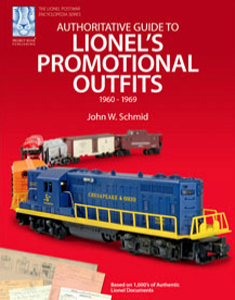
A: The original set that became known every bit the Halloween set was made past Lionel equally a promotional gear up for the Druggists' Service Counsel, Inc. and offered to its member stores through their Gifts Galore catalog. According to John Schmid's excellent resource, Authoritative Guide to Lionel's Promotional Outfits 1960-1969, 7300 of these sets were produced in 1960. The orange and black loco and the blue rider car make this gear up quite unique. The set did non accept individual boxes, but was displayed in a single big box. The fix included a Frontier ready, made by Bachmann'southward Plasticville, a pocket-size transformer and enough O27 rails to make a effigy viii layout. Information technology's value is highest when the original big display box and the Frontier set in Lionel's packaging are included. Y'all tin can read more about it in the above mentioned volume, available from Project Roar Publishing.
Sears likewise had a fix numbered 79 Northward 09666. It was cataloged in the 1959 Sears Christmas Catalog. John Schmidt'due south excellent documentation of sets begins in the year 1960, so this set was not included. The catalog moving picture is in black & white, but the description describes the loco as " blackness, ruddy and gold-color. " The set appears to exist the usual General ready with a yellow coach, a yellowish baggage car and the curt flatcar with fences and horses. I believe the flatcar might have been numbered differently than the standard one and may take been a dissimilar color, but I believe the loco and cars were the usual Lionel colors - non the Halloween colors. The set also came with an 18 slice plastic frontier outfit with windmill, building and animals. The picture also shows argue sections to coral the animals. The price was $25.89.
Q: I take given upwards trying to discover information about my not bad granddaddy'southward adolescence train. Equally y'all can see the military railroad train has a tank locomotive with a flashing light at the cease of the tank cannon which flashes like cannon burn down as the turret sweeps from left to right. In addition the railroad train prepare as simply two olive drab box cars "O" gauge. I would very much capeesh whatsoever information, or location, email that might assist me in gathering more information.
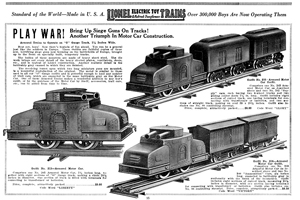 A: The set you have was first listed in Lionel's 1917 catalog, under the headline – Play State of war! Two sets were produced each with dissimilar cars. Ane set had the armored motor auto and two no. 702 Supply cars. That set, outfit no. 215, sold in 1917 for $eight.00. A complete fix included in improver to the loco and cars, 8 sections of curved runway and two sections of directly, along with a no. 88 controlling rheostat. The second set came with ii no. 900 Ammunition cars. This set up had no straight runway, just the curved, and sold for $half dozen.50. These sets were offered in the Lionel catalogs through 1919. Your photos friction match this second set. This prepare has been reproduced in recent years and the original is quite rare. Value depends on condition. Having the original box adds greatly to the value. Your set looks well worn, but due to its rarity, it is a desirable set. A browse of the 1917 itemize page on which this train was introduced is shown hither.
 Q: I recently bought a mail war navy set up at a auction. The box is marked x646. I don't think this is the right # equally I recollect it could be x628. My biggest trouble is the submarine machine is missing. I would like to know the correct # car. Is the correct car #3330 or #3830. They both have the 3830 Sub on them?
A: The X646 fix and the X628 gear up are very similar. Both were produced in 1961. One of the major differences is that the items in the X646 set were individually boxed. This is indicated by the –25 in the part numbers. The two sets have like cars except for the Submarine car. The X628 came with a boxed 3830 Submarine automobile. The X646 came instead with a 6062 unboxed black NYC gondola and three orange cable reels. The Helicopter car in both sets (3410) is the manual type which cannot exist operated remotely. The one in the X628 set had a box.
If you lot collect promotional sets from the 60s, the best book around is,Authoritative Guide to Lionel's Promotional Outfits 1960-1969. The book is almost 2 inches thick and has all the data you would need –even exactly how the items were packed in the box. The volume was published by Project Roar Publications.
Q: I have a question virtually the history of the 6464-100 built in 1954-1955. There seems to be a lot of confusion surrounding these cars. Mine is an orange 6464-100 built in 3/54. But that does not jive with the explanation that these were built in 1955. It seems like the only ones built in 1954 were orangish every bit well but only had a number 6464 and was a limited production run.
A: First, the 6464-100 in orange was made in 1954 – non 1955. The interesting thing about the orange car is that the right box for it is really labeled 6464-250. The car really had the number 6464100 on it. This machine is the almost valuable of the Western Pacific 6464 boxcars. A much subsequently version made in 1966 was numbered 6464250 on the car. The 1954-1955 version is the silver car with a larger yellow plume and was also numbered 6464100 on the car. I am unaware of an orange version with only 6464 on the car.
Q: Are there any obvious differences between the 773 from 1950 and the one from 1964?
A: At that place are some very meaning differences between the 1950 model and the 1964 model of the 773. When first introduced in 1950, the 773 was but offered for one year. It did non appear again until 1964, when information technology was offered through 1966. On the 1960s version, the slide valve guides on the rear of the steam chest were eliminated. The paint finish was a chip glossier and the cab numbers were slightly larger. The most pronounced difference was the tender. The 1950 version came with a die-cast metallic tender. The 1960s version came with a plastic Pennsy style tender which in the 1964 was lettered for Pennsylvania. In 1965 and 66 it was lettered for New York Key. The tender is actually too small for the calibration sized loco and the trucks on the tender were plastic.
Parts and Service for My Trains
Q: I'd like to run my old Lionel Trains. Are parts and repair services still available?
A: Yes! Many parts for trains made throughout Lionel's history are still available. Reproductions of difficult to discover parts are also available. Lionel still maintains Authorized Service Stations with trained specialists who can non only repair electric current production, just as well older Lionel products. You can cheque for a local Service Station at Lionel's website - www.Lionel.com nether the client service tab. You might besides check local hobby shops. The service manual can help you identify parts which tin can then be purchased. For more than current product, Lionel offers instruction manuals and exploded parts diagrams which are viewable on their website www.lionel.com.
Members of the LCCA receive The Lion Roars, five times a twelvemonth. This magazine features layout photos, reviews of current products, and tips on running and repairing Lionel trains. Back issues of the magazine are as well available to members online.
Q: I have recently received a model railroad train that has been sitting idle for over 35 years. It is a Lionel 2026, wheel configuration is 2-6-4. From what I can notice, this is a post-war (51-53) manufactured railroad train. My first problem is that the tracks (outside heart to outside centre of a 3 track rails) is 1.375". All I've read is that the O gauge should exist 1.25". I am confused on what I actually have. I want to recondition this set for grandchildren. I have no info on the set. I need tech manuals and operator manuals. The transformer is a mess and I'1000 a petty worried about replacing the cord and plugging in. Any info you lot may have to share would be appreciated. Whatever info on obtaining tech manuals would also exist appreciated.
A: The track yous have sounds right. The i.25" dimension should exist an inside measurement BETWEEN the two outer rails. In that location are several versions of Lionel's postwar service transmission available. In reduced size printed format, it tin be purchased from Kalmbach Publications - world wide web.classictoytrains.com. An first-class digital version with full sized printable pages also available from www.hslinc.com. Be wary of some of other digital versions advertised online - they are grossly incomplete and hyped with deceptive ads. I would be cautious about repairing the transformer. Lionel doesn't even let their service stations to repair them. It is the one spot where you have 110 volts. If yous are qualified electrically, the cord can certainly be changed, but the transformer should be tested and assured safe before passing information technology on to your grandchildren. The service manuals listed above practise requite technical details on many of Lionel'due south transformers. If you have a hobby or train shop that sells Lionel, you may be able to purchased a use transformer for a reasonable price.
Q: I am "resurrecting" some of my 1950's Lionel collection and have a #3927 Cleaning Car. It requires a new brush and cleaning fluid and cotton swabs for wiping the rail. Practice you know if these are yet manufactured and if I could purchase replacement parts? Or should I contact Lionel directly?
A: The postwar 3927 was introduced by Lionel in 1956. The sponge ring and cotton fiber swabs are nevertheless available from many Lionel parts dealers, but not direct from Lionel. I did a quick Google search and found them sold by at least one dealer. They are listed in the parts department under no. 3927. I'm sure other parts dealers too accept them. Lionel cautioned dorsum and then to simply use Lionel's cleaning fluid, which was a non-flammable detergent fluid. I have heard from others that the Life-Like runway cleaning fluid is a good choice. The important thing is that you don't want to utilize anything flammable or anything that volition set on plastic. I besides sympathise that Lionel's postwar track cleaning machine is not every bit efficient at cleaning as one might hope. Information technology is certainly worth a endeavor though.
Q: I accept some lube grease from a 60+ twelvemonth former 927 lubricating and maintenance kit. Can it withal be used finer to lubricate my Lionel trains?
A: Yous should definitely NOT use the one-time Lionel Lubricant. Save the tube every bit a memory of postwar Lionel, but don't use it on your trains. Today'southward lithium lubricants are far superior than Lionel'south mix of oil and soap. Lionel's lube volition in time dry out leaving a hard and unsuitable residue that must exist cleaned out. Some of Lionel's postwar accessories which used this lube, i.eastward. No. 364 Lumber Loader, will function and so much improve if the old lube is removed, the gear case cleaned, and modern lithium grease added to replace the old lube. THe original Lionel Lube has not been offered by Lionel since the 1960s. Current Lionel Maintenance kits include a lithium based lube.
Q: I have The Prairie Blazon ii-6-2 Locomotive, No. 2025. Last winter I decided to make clean and oil it, since information technology looked like it needed it. When I put it dorsum together it would but go backwards. I must accept put some parts back together incorrectly, only I don't know which parts. And when I move the direction switch behind the smoke stack, information technology makes no difference. Too pressing the opposite button on the transformer makes no divergence either.
A: Information technology sounds like your east-unit of measurement is stuck in ane position. First exist sure that the e-unit lever is in the right position. In one position it locks the e-unit of measurement. In the other position information technology allows the normal forward-neutral-opposite-neutral operation. Try the loco with that lever in each position. If that does not solve the trouble, you lot'll accept to remove the banality shell and audit the e-unit of measurement. Check its operation with the banality beat out off and make sure the e-unit lever is making proper contact. In the position you want information technology in, information technology makes an electrical contact. If that lever is loose, that contact might not be being made. Also check that the plunger in the e-unit of measurement is able to motility and not jammed.
Operating My Trains
Q: What kind of track is best for my Lionel trains?
A: Lionel trains run on 3-track O gauge track. In contempo years Lionel has introduced a new line of track called FasTrack. This new rails organization has proved to exist quite popular and offers a wide range of track sections. The sections snap together and due to its unique construction, the mating pins at each end of the rail never need to exist removed, regardless of the track configuration. Other track options include Lionel'southward traditional tubular rail, and rails offered by such companies every bit Atlas and Gargraves.
Q: What Radius do I need?
A: Three rails track is available in a variety of radii. Both O and O27 track are the same gauge - meaning that the spacing of the three track is the aforementioned. They differ however in height and radius. The smallest radius available with Lionel'southward O27 guess tubular rail provides a 27 inch diameter. Lionel'south O estimate tubular rail has a larger diameter of 31 inches. FasTrack sections brainstorm at a 36 inch diameter. Today Lionel makes many scale locomotives which will not run on a diameter that pocket-size and therefore wider radius curved track is too available. FasTrack for example, is bachelor in diameters of 36, 48, lx, 72, and 84 inches. It is best to choose the largest radius your space will allow.
Q: Just bought a Lionel 2055 steam loco with smoker that is supposed to work well. Please tell me what kind of smoke product to buy for information technology. Tin I utilize fluid or pellets and are they all about the aforementioned?
A: The 2055 is a postwar loco fabricated from 1953 to 1955. It used Lionel SP smoke pills. The pills were heated by a nichrome wire element. Ofttimes in an old locomotive this element may be broken. If broken, the loco volition not smoke. If it is in good condition, y'all would need the pills to brand smoke. These are hard to discover today and often expensive when you do find them. You can however purchase a conversion kit which replaces the original smoke unit of measurement with a more mod ane that uses smoke fluid. The fluid is very available and at reasonable toll. Doing the conversion is not hard, simply does require soldering some connections. It is the all-time answer for an old steam loco.
Q: Can you operate Lionel trains in areas of the earth where the electricity is other than 120V? What do I need to do that with?
A: According to Lionel's caput of customer service, on the underside of their CW80 transformers, starting in late 2009, the vendor practical a sticker that states "QC50" on it. This signifies compatibility with l Hertz ability. The customer will still demand a pace down transformer to get the 220V to 110V. The train, nevertheless, should merely have a whistle or a horn or an electronic whistle. If information technology has TrainSounds it volition non function properly on 50H. If it has Railsounds RTR it will besides not function on 50Hz.
Q: I am restarting with my old Lionel trains. I take a Type R 110 Transformer, only I don`t have any transmission. So I do not know how to connect it to the runway. Can y'all help me, and then I won't do a brusque circuit and possibly damage my locos.
A: I've attached a scan of the instructions for the Lionel Type R transformer. I do have a word of circumspection however. The R transformer is a pre world war 2 version that was manufactured through 1947. I would be cautious using a transformer that is over 60 years old. Chances are ameliorate than even that your cord should be changed. For safe operation, I would recommend that you purchase a modernistic transformer. Y'all can purchase a new Lionel transformer. The CW-fourscore would exist a current model and offers 80 watts. The Type R that yous take was rated differently back then and did non really deliver the total 110 watts. Much of this was lost in heat. The current rating organization is more than accurate and the CW-80 would supply equally much power equally yous R transformer. Some other source for AC transformers is the MRC company.
Q: When operating my trains at that place are some spots in the track where the railroad train either stops or slows up. What is wrong? Do I need a new transformer?
A: There could exist several causes for this. First, I have a few questions. Does this e'er occur at the same place? And is that place opposite the place on your layout where he wires are connected from the transformer? If so, you lot may need an additional feed from the transformer to that portion of the layout. Y'all don't need another transformer, only connect another set of wires to a place on the layout which is every bit far from the original connection as possible. This is peculiarly necessary if your layout has been expanded with additional track. The larger the layout, the more feeders yous might need.
Another affair to bank check is electrical continuity through the track. The all-time way to check this is with an Multi-meter. If you lot have one of these, ready the meter to read Ohms - or resistance. In this mode, when the ii leads of the meter are touched together, yous will get a nada reading. A nil reading means that in that location is electrical continuity. Place one lead on one of the exterior rails and then place the other pb on the same runway of the next track. You lot should go a zero reading. Continue around the layout checking each section of track with the ane next to information technology. Repeat this with the heart runway. If you become a state of affairs with no reading, it means there is a interruption in electrical continuity and there is a trouble with the connection between those two pieces of track.
Q: What is the Lionel number for a whistle controller that will activate the "whistle" on a newer Lionel locomotive when using a vintage 1033 transformer?
A: What you lot need is what Lionel calls a Sound Activation Button – No. 610-5906-001. It is specifically designed for transformers without a Bell or Whistle controller. I've located an instruction page that explains how to claw it up for either bong or whistle. To do both, you would need 2 of these buttons. Lionel sells these on their site in the parts department. Click here for Lionel's Service website with the button information and ordering.
Q: I want to pull a long freights on a 072 Fastrack (box cars, intermodals, flat cars--loaded, gondolas--loaded) thusly what Lionel locomotives take the power to pull this load of 25 pieces or more of rolling stock?Exercise I need ii engines pulling this set up-upwardly and how do you make both engines sync with each other to avoid i pulling to difficult and the other lagging and dragging the other ane downwardly and causing undue article of clothing on the engines in the locomotives?
A: The number of cars that a item locomotive can pull involves many variables including number of motors, type of cars, weight of cars, whether postwar or modern era cars, etc. Twenty-five cars will probably require more than ane locomotive. With postwar locos and conventionally operated locos, information technology is usually advisable to lock the Eastward unit of measurement of each loco in the frontward position. This prevents ane of them from going into neutral or reverse if an unexpected break in power occurs. For best results, you would probably desire to utilise two like locos, i.eastward. ii F3s. You lot shouldn't have whatever problem with modest variances in speed.
If you are running in Command Command, TMCC or Legacy, you tin can link more than one loco together and treat them as a unmarried loco allowing very precise command over the loco'southward speed. In demonstrations, I have seen 2 locos linked in this way, but not coupled together - leaving i/2 inch betwixt them. When run, as a linked pair, they remained 1/2 inch apart as they went around the track. In do of grade yous would couple them, but this demonstrated how well the two were controlled as one.
Q: Can I operate Bachmann (Williams) trains on my Lionel layout and track? Practise I need a special transformer for them? Volition the horn an bell operate on a Lionel transformer?
A: The Williams by Bachmann trains will work merely fine on Lionel runway. They are made to operate on Lionel layouts and you should accept no trouble. The Williams whistle and bell operate using a DC pulse - this is exactly as Lionel's do. Some older Lionel transformers volition non take a bell button, but an auxiliary bell push button can exist purchased and will work fine with an older transformer. If you have a transformer with a bong push button, it is of import which wire goes to the center rail and which is ground. If you find the whistle button operates the bell, simply reverse the wires to the rail. You should have no problems using a Lionel transformer to operate Williams locomotives.
Q: I read with interest recently about calibration auto cars. You stated that the newly designed coupler was made in such a way to allow these cars to be used on not-prototypical radii. Does that hateful they tin can be run on 027 runway and/or 042 rails? My layout consists of several 042 curves.
A: I'm afraid the the smallest radius that these new scale car carrier cars will function is O54. O27, fifty-fifty with O42 curves is too tight a radius. I've non actually tried the cars on annihilation smaller than O54, but that is the recommendation for the cars. Even O72 curves are non-prototypical for real railroads which actually ride on larger radius curves.
Sizes of Lionel Trains
Q. I was recently told that Lionel box cars are shorter than bodily O-gauge/O-scale (1/48). Can you clarify this for me?
A: Today Lionel makes several different size box cars. The traditional line cars, like the 6464 type boxcars are shorter than calibration. These originally came out in the 1950s postwar period, when very piddling if anything Lionel made was true calibration. The F-3 and the Trainmaster locos came close, but were non true scale by today's standards. Today Lionel's line does include scale cars and their itemize refers to this line as Calibration cars. They do even so retain the Lionel coupler which is much larger than a scale coupler would exist.
Q: Did Lionel make HO trains? I take several including a Rock Island Husky and a Santa Fe engine which says fabricated in Canada.
A: Yes, Lionel marketed and/or made HO trains at several points in their history. Lionel has not had much success in the HO market. Lionel first introduced an HO line in 1957. This ran through 1966. The Rock Island Husky y'all accept was introduced in 1960 and was the least expensive loco offered. The HO trains from this era are more highly valued than those of Lionel's second attempt under the General Mills era from 1973 to 1976. Your Santa Atomic number 26 loco is from this second era, when Lionel trains were manufactured by Fundimensions, a division of General Mills. The all-time Lionel HO trains were those produced in 1957 as they were manufactured for Lionel past Rivorossi, a manufacturer of loftier quality HO trains. Lionel then manufactured its own line and the quality suffered. There are some collectors who value the beginning era of Lionel HO, but few who identify whatsoever value on the those produced in the Fundimensions era. I would not consider either of your locos to be rare, but at that place is a modest grouping who practise collect Lionel HO. While there are some rare cars and locos which are especially collectable, most accept a rather pocket-size value.
Lionel Fastrack Layouts and Operation
Q: I have a FasTrack uncoupler that works with my Up #36811 unloading coal car but not my 'operating poultry motorcar'? Do I need to buy an operating track also or can I use my uncoupler tracks AUX. input and purchase a double switch remote command?
A: Just to be sure we're both talking about the same thing – I am assuming that yous have the FasTrack uncoupling section. This is a 5 inch long track with a magnet in the center and a single push to control it (No. 12020). This runway should operate any car that has a central plunger that must be pulled down to operate. If the car has sliding shoes on its trucks, then y'all demand the Operating Track (No. 12054). The operating track has a two button controller – ane button controls the inner control rails and the other controls the central magnet.
Some work with a central plunger and others work with the sliding shoes. The operating Poultry car uses the central plunger activated by the uncoupling magnet. The poultry car should work with either type of track. Utilize the uncouple push and the magnet should pull down the plunger under the poultry car. Move the car slightly to check that it is in the best position to be pulled by the magnet. On some cars the tolerance is quite close. If it still does not work, test that the magnet is energizing by holding a screwdriver blade over it when the button is pressed.
Q: On all my new O-guess and FasTrack rails I adult a black greasy film. What is the possible cause? It does remove easy with track cleaner. The track has been in service for 6 months. The track when purchased had an oil film. I cleaned information technology before placing it in service with track cleaner. Should I have used a "de-greaser" chemical? Can material come up off the wheels of new engines or is it the traction tires? Does rail cleaner deteriorate the traction tires? The picture show continues to come back. The film is always on the outer rails but still forms on the middle rail.
A: The black film yous have noticed is quite common. Every time Lionel sets upwards their big display layout, they use denatured alcohol on a rag to wipe downwards the track and it takes several paper towels or rags as they become quite black. I believe this black comes from the wheels of the cars and loco. Most wheels today are made via the pulverization metallurgy process. On some of the display layouts, the loops are pocket-sized and the trains run for many hours. On the towers that Lionel has on its largest layout, each has several circles of FasTrack and the trains run constantly on them and e'er in the same direction. On these, wear of the wheels can conspicuously exist seen. Since the loop has no directly tracks the clothing occurs faster and since the train is always going the same direction, the wheels on one side wear much faster. I've seen some of the wheels actually become sharp due to this wear.
Any track cleaner that you employ, should be wiped off the track earlier running trains on information technology. I don't know how dissimilar track cleaners effect the traction tires. Denatured booze works well and is quite inexpensive. I don't think there is any style to prevent this build upwards if you run your trains. You are doing the right thing by cleaning it off when necessary.
Q: Need some help on Lionel FasTrack. Building a wall/ceiling fix-up and want to run 2 tracks side past side. The room allows only a maximum .036 curve in the corners, especially since ii curves will be through closets (tunnels). Now ,that said, I'll demand a tighter radius inward of the .036. In "FasTrack" Lionel has a .031 bend every bit the tightest. Will this run nicely parallel to the .036? I plan on FasTrack throughout, so the former three rail, 3 tie .027 is out.
A: The FasTrack system was designed to run tracks as close every bit a center track to eye rails distance of 6 inches apart. The number designations, i.due east. O36, O48 etc., refer to the middle runway diameter of a circle fabricated with the rails. And then, an O36 circle volition fit within an O48 circumvolve with a distance of 6 inches from heart rail to centre rail. The new O31 track was fabricated to improve accommodate a four 10 8 sheet of plywood and too to allow y'all to duplicate many previously published layouts originally designed for the traditional tubular track. But – an O31 curve volition definitely NOT fit within an O36 bend.A circle made with O31 track is only 4 inches less in diameter than the O36 – which ways that if an O31 circle is placed within an O36 circle, the center rails to centre rail distance would be only 2 inches. If you butt two pieces of FasTrack together, the very closest you tin come is three 3/8 inches middle to center. The O31 FasTrack curve was an adaptation to requests for a smaller radius, but it is non part of the regular FasTrack geometry that all other FasTrack sections were made to work within.
Q: Has anyone had whatsoever luck running prewar trains on Lionel'south FasTrack? Or, should I only stick to tubular O?
A: Lionel prewar O estimate will run just fine on FasTrack. Lionel'south prewar Standard Gauge is too large. If you are operating Standard Gauge trains, MTH Trains has a FasTrack look akin in Standard Guess.
Q: I have at least 16" in length for a new train fix upwards. I would like to run two tracks of Lionel FasTrack, one of 060 degree and one of 036.Would you please advise how much width I will demand to make the turns.
A: The number part of the radius designation, i.due east. 36 for O36, indicates the measurement from the eye rail to center rail of a circle fabricated without straights. To figure the actual tabular array space taken up by a particular radius of FasTrack, only take the number in the designation, and add iii 3/8 inches. And then for O36 rails, a circle without straights volition crave 39 3/viii inches of width on the tabular array. For the O60, the width of a circle would be 63 3/eight inches. FasTrack has been designed so that you tin can space rail half-dozen inches on center autonomously. So if your inner rail is O36, you could run an O48 loop of rail vi inches outside of the O36 loop, and an O60 loop 6 inches from that.
I've created a drawing which shows a half circumvolve of O36, O48, and O60. The drawing is to calibration and each square of the graph equals 12 inches. The width of each half circle is 39 3/8 inches, 51 3/8 inches and 63 iii/8 inches. There is 6 inches from center rail to center rail between each loop.
LCCA Fastrack Modules and Standards
Q: Our railroad train club bought the jig for the new LCCA module arrangement. We have one other need which is the leg braces practice you accept a manufacture that you tin can buy these from nosotros don't have a large budget and nosotros really like the module system.
A: Nosotros've had several requests for the leg braces. Nosotros are currently working on putting together a hardware kit which will contain all of the hardware, including the electricals, Rotolocks, leg brackets etc., just no woods. this will exist less expensive than the entire kit. We expect to finalize that soon.
We've created an improved leg subclass we at present employ. This new design is better able to hold the wooden legs regardless of their exact size. These are custom fabricated for the kits and are not standard hardware. They will be included in the to a higher place kits. I also program to detail a method of securing the legs which does not require the subclass, just uses a Tee Nut. Once completed, we will post a notice on the LCCA website.
Q: Only downloaded and read the LCCA module manual. I have a couple of questions. I see your 'Reversible Corner' does a flip flop on the radius of rail. Using a 'L' Shape Module Program the 084 track on the exterior goes to a 072 on the outside when information technology hits the 'Reversible Corner'. Then the 072 on the within hits a 084 on the 'Reversible Corner'. I understand this gets down to radius and geometry. My interest is that I accept this layout in a single loop and am looking to exercise this with iv to five loops. Not sure if this 'Reversible Corner' tin can exist made with all these loops. My thinking is a stepping of corners and short straights.
A: You are correct nigh the reversible module. The change in radius presents no problem as all of Lionel's locos will run on O72 track. You mention putting 4 or 5 loops. I don't believe that could be done with the module as we have it. Hither is an illustration I prepared for an article showing how the unlike radius sections of Lionel's FasTrack work together. The FasTrack organization was designed to allow the eye rail to middle rail distance betwixt loops to be every bit close every bit 6 inches. The O31 rail section was recently introduced and does non really fit with the other radii. It does however allow you to indistinguishable the many published layouts that were designed for Lionel'due south traditional tubular track.
Q: Our model railroad club purchased eight #vi-37153 reversible corner modules. Today when nosotros went to get together the modules, it was determined that the plywood end table rail (2 per module) were too short. They measure xi 1/2 inches. The drawing shows one ft and one/iv inches or 12 1/4 inches. We have the plywood tops cut and they mach the template perfectly. The notch for the latch appears to exist in the centre so both ends are cut off too curt.
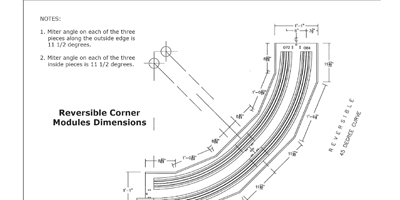 A: I believe you lot have made a mistake in cut the plywood. If you cutting the plywood to match the template, you cut information technology too large. The template is to be used to get together the frame – not the plywood. I've created a graphic from the drawing. The outside dimension of the end of the frame is 1' i", or 13 inches. The correct size for the end plywood pieces is 11 ane/2 inches. The terminate piece goes between the two iii/4" pino pieces – making a full width of xiii inches.When assembling the kit, the outset affair to do is to gather the frame – plumbing equipment it to the template. Once the frame is completed y'all tin marking out the size of the plywood. This is shown on the video and I would recommend you lot watch that. Here's a link to the video. Once there, roll downward to the video. And here's a link to the transmission.
Lionel Client Programs
Q: One sees from fourth dimension to time LIONEL Ambassador Runway cars for auction ( marked : Thank you ) These seem to be available on three levels / Statuary / SILVER / GOLD. Almost train collectors will tell yous these are the "rarest" of the Lionel public offering. When and where were these cars awarded and what was (is?) the Lionel Ambassador program? What dates? What are the most (Most-est) "rare" of all the Lionel modern rolling stock?
A: To the best of my recollection, Lionel's Ambassador Programme ran from from 1998 through 2000. Train enthusiasts could apply to go an Ambassador. Upon acceptance, you were given points for assisting Lionel in a variety of events. Some of theses included profitable at a Lionel effect sponsored past a local Lionel dealer, helping Lionel fix for an upshot and so on. If you accumulated enough points you could earn a bronze, argent or gold level special Lionel car. Of these cars, the golden level ones were the most rare as few ambassadors earned plenty points to qualify. In addition to the cars there were also awards of particularly labeled Lionel Jackets. During the three twelvemonth duration of the program, Lionel held two Ambassador conventions - the first in Durango, Colorado and the second at the Carnegie Scientific discipline center. Awards were presented at these conventions.
Choosing a particular car to characterization every bit the most rare of all is a difficult and subjective task. The most desirable items change over time and basically comes downward to a question of but how important a particular piece is to you.
Software - Inventory, Track Planning, etc.
Q: Tin you recommend a collection inventory management software awarding? Looking for a Lionel production where I tin put in the role number and the description comes up. Also price I paid and engagement bought.
A: In that location are a few commercial software programs available that say they provide such information. Every bit these may run into the needs of some, the LCCA recommends you consider using a digital worksheet (i.e. Excel, Numbers). Self adult programs exercise require you enter all descriptive data, but can be as elementary or as complex as you lot want. A positive aspect of your own digital worksheet is that you update, place, modify to meet your special requirements. And as you and your drove identification needs change, the worksheet can be modified to suit these changes. The LCCA will exist posting an excel spreadsheet template which you tin can use every bit is or change as needed.
Storage Conditions and Packaging of Trains
Q: Would information technology exist inadvisable to store my engines and rolling stock in a garage where temperatures can drop below freezing for extended periods of time?
A: Extreme temperatures, either hot or cold are best to stay abroad from. Freezing temperatures will certainly stiffen whatsoever grease and thicken oil. I tin't be sure if this would cause any permanent damage. The garage may also exist discipline to high humidity in the Summer and that volition cause rust on steel parts. Ideally, you want to store the trains in a dry out area and avoid extremes of temperature.

Source: https://www.lionelcollectors.org/ask-our-experts/faqs.aspx
Posted by: comerolvery.blogspot.com
0 Response to "How To Clean And Maintain Lionel Postwar Locomotive"
Post a Comment