

How To Change Powershell To Cmd In Windows 10
By default, PowerShell restricts running scripts on end user PCs. This setting is proficient from a security point of view. Still, if you lot are using a lot of scripts that you accept downloaded or coded past yourself, information technology can be really annoying. In this commodity, we will review how to change the default execution policy for PowerShell scripts in Windows 10.
Windows PowerShell has 4 different execution policies:
- Restricted - No scripts can be run. Windows PowerShell tin be used only in interactive mode.
- AllSigned - Only scripts signed past a trusted publisher can be run.
- RemoteSigned - Downloaded scripts must be signed by a trusted publisher before they can be run.
- Unrestricted - No restrictions; all Windows PowerShell scripts can be run.
- Undefined - No execution policy has been set up.
If the execution policy is non fix and not configured, it is displayed as "Undefined". Here is how you can see the electric current value.
How to encounter the PowerShell Execution Policy
- Open up PowerShell.
- Blazon or copy-paste the following command and printing the Enter cardinal:
Get-ExecutionPolicy -List
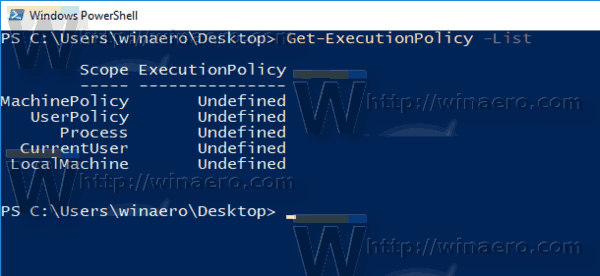
The command volition brandish all execution policies. Equally you can come across, at that place are a number of scopes for which the execution policy can be defined. Information technology tin be fix globally for all users, for the current user simply, or for the current process. The current procedure policy has priority in a higher place the electric current user'southward settings. The electric current user policy overrides the global selection. Go on this in heed. Now, allow'due south see how to change the script execution policy for PowerShell.
Change the PowerShell Execution policy for a process
- Open a command prompt or PowerShell.
- Launch the powershell.exe file with the -ExecutionPolicy Unrestricted argument. For example,
Powershell.exe -ExecutionPolicy Unrestricted -File c:\data\test.ps1
This will first your script using the Unrestricted execution policy. Instead of the script, you can start a cmdlet or what you lot desire. Instead of "Unrestricted", you lot can utilize any other policy mentioned higher up.
Tip: For an open PowerShell console, you tin switch the execution policy using the control:
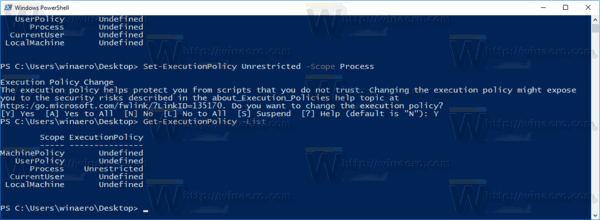
Fix-ExecutionPolicy Unrestricted -Telescopic Process
Information technology volition remain active until you close the current PowerShell window.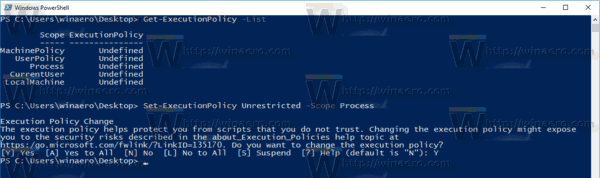
Change PowerShell Execution policy for the current user
- Open PowerShell.
- Type or re-create-paste the post-obit control and printing the Enter key:
Ready-ExecutionPolicy Unrestricted -Scope CurrentUser
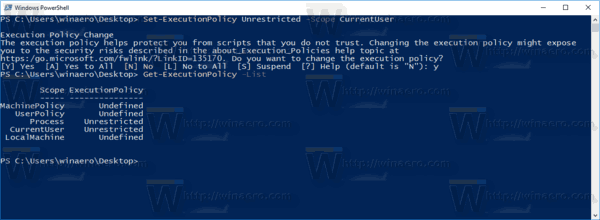 Tip: If the policy is not set afterwards the command above, endeavor to combine it with the -Forcefulness statement, like this:
Fix-ExecutionPolicy Unrestricted -Scope CurrentUser -Strength
When the execution policy is set for the current user, information technology will override the "LocalMachine" scope. Once again, for a process, you lot can override it for the current PowerShell instance as described to a higher place.
Change the global PowerShell Execution policy
This execution policy applies to the reckoner, meaning it is effective for those user accounts which take no execution policy applied individually. With the default settings, it will be practical to all user accounts.
To change the PowerShell Execution policy in Windows 10, do the following.
- Open up PowerShell as ambassador.
- Execute the post-obit control:
Set-ExecutionPolicy Unrestricted -Scope LocalMachine
You are washed.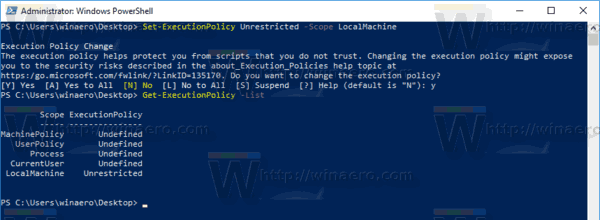
Modify PowerShell Execution policy with a Registry tweak
It is possible to modify the execution policy with a Registry tweak for both the electric current user and the computer. Here is how it tin can be done.
- Open the Registry editor.
- To change the execution policy for the current user, get to
HKEY_CURRENT_USER\SOFTWARE\Microsoft\PowerShell\ane\ShellIds\Microsoft.PowerShell
- Set the cord value ExecutionPolicy to ane of the following values: Restricted, AllSigned, RemoteSigned, Unrestricted, Undefined.
- To alter the execution policy for the LocalMachine scope, go to
HKEY_LOCAL_MACHINE\SOFTWARE\Microsoft\PowerShell\i\ShellIds\Microsoft.PowerShell
- Gear up the string value ExecutionPolicy to ane of the following values: Restricted, AllSigned, RemoteSigned, Unrestricted, Undefined.
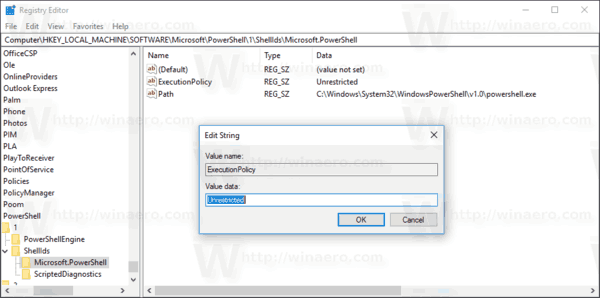
Tip: Run across how to go to a Registry key with one click. Also, you can switch between HKCU and HKLM in Windows ten's Registry Editor quickly.
That's information technology.
Support the states
Winaero greatly relies on your back up. Yous can help the site keep bringing you interesting and useful content and software by using these options:
If you like this article, please share information technology using the buttons beneath. Information technology won't take a lot from yous, simply it volition help united states grow. Thanks for your back up!
Source: https://winaero.com/change-powershell-execution-policy-windows-10/
Posted by: comerolvery.blogspot.com
0 Response to "How To Change Powershell To Cmd In Windows 10"
Post a Comment